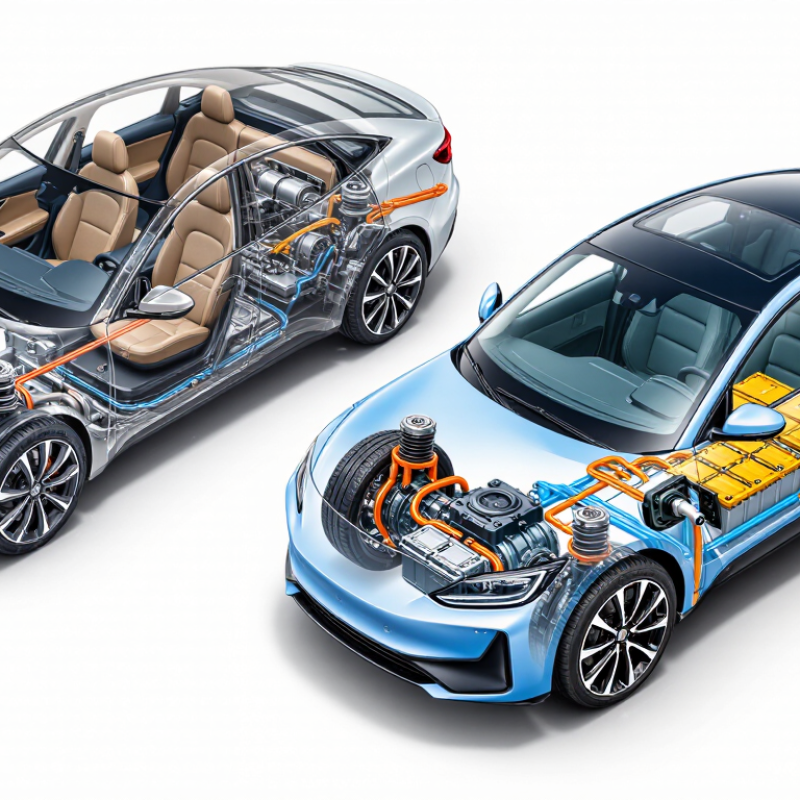
An electric vehicle may share its body, tires, brakes, and cabin with a traditional car. Under the surface, however, its powertrain works differently. A gasoline vehicle depends on an engine, fuel system, exhaust, and multi-speed transmission. An EV instead uses a battery pack, electric motor, inverter, and charging hardware. These systems bring different materials, operating temperatures, and service needs.
So, why are electric vehicle components different from traditional vehicle parts? The short answer is their energy source and the way they deliver power. A high-voltage battery stores energy, while an inverter controls electricity flowing to the motor. Cooling circuits help manage heat in the battery and power electronics. Even the brakes can work differently: regenerative braking uses the motor to slow the car and recover some energy. Small details matter. A connector’s condition, for example, can affect charging or system performance.
The differences are significant, but not absolute. Many EVs still use familiar suspension, steering, tires, and cabin components. Some parts also vary by manufacturer, model, and battery design, so broad comparisons can be misleading. That is worth remembering. This article explores how major EV components compare with conventional car parts, why their designs differ, and what those differences mean for maintenance and reliability. It also considers a practical question: when does an unfamiliar component require specialist knowledge, and when is it simply a modern version of a familiar part? The answer is not always obvious. A little humility helps.
An electric motor replaces the engine’s repeated combustion with electromagnetic force. DOE reports that electric motors can reach 85–90% efficiency, converting much of their electrical input into motion. The exact figure depends on the motor, load, and operating conditions. It is not a promise that every trip uses energy at that rate.
Picture an EV pulling away from a traffic light: the motor delivers torque quickly, without waiting for fuel and air to burn. Fewer moving parts also mean no engine oil changes or exhaust system to maintain. Less mechanical clutter. Yet an EV still has components that need care, including cooling circuits, bearings, and power electronics. Efficiency figures can sound cleaner than real driving feels; cold weather, steep hills, and fast acceleration all affect energy use. The motor may be highly efficient, but the full vehicle must also carry a heavy battery and manage heat. That detail is easy to overlook when comparing motors alone.
An electric vehicle replaces the fuel tank, pump, and exhaust system with a high-voltage battery, power electronics, and an electric motor. The battery pack is more than stored energy: it includes cooling channels, sensors, wiring, and controls that help manage temperature and power.
BloombergNEF reported an average lithium-ion battery pack price of $139 per kilowatt-hour in 2023, a 14% drop from 2022.
That figure is an industry average, not a guaranteed price for every vehicle or battery chemistry. Still, it shows why battery costs strongly influence EV design and affordability.
At $139 per kilowatt-hour, a 60-kWh pack implies about $8,340 in cells and pack-level costs at that average rate. Real costs vary. Pack size, chemistry, manufacturing location, and supply contracts all matter. The International Energy Agency’s Global EV Outlook 2024 also noted that battery pack prices fell in 2023, reflecting lower material costs and manufacturing improvements.
Engineers must balance range against mass, cooling needs, and cost; adding capacity is not a simple upgrade. A battery pack can last many years, but its performance changes with use and temperature. And the price benchmark leaves out the vehicle’s motor, inverter, and charging hardware. It is a useful number, but an incomplete picture.
Power electronics are the working bridge between an EV’s battery and motor. The battery supplies direct current; an inverter switches it into controlled alternating current for the motor. A separate DC-DC converter feeds lower-voltage systems, while the onboard charger manages grid power. These parts do more than replace familiar engine components.
Voltage matters. At the same power, an 800-volt system carries about half the current of a 400-volt system. Lower current can reduce cable losses and allow lighter conductors, but higher voltage demands careful insulation, cooling, and fault protection. Inside the inverter, fast-switching semiconductors handle substantial heat. A connector, coolant channel, or control setting can affect performance. The hardware is compact, but not simple.
The scale is growing. The International Energy Agency’s Global EV Outlook 2024 reports nearly 14 million electric-car sales in 2023, about 18% of global car sales. It also estimates EV battery demand exceeded 750 GWh that year, around 40% above 2022. These figures show why power conversion must work reliably across millions of vehicles. They do not mean every EV uses the same voltage or layout; packaging, cost, and charging needs still shape design. And voltage alone is not the whole story. (IEA, Global EV Outlook 2024)
| System or component | Battery-electric vehicle | Traditional gasoline vehicle | Why the difference matters |
|---|---|---|---|
| Primary energy storage | Rechargeable traction battery; many passenger EVs use lithium-ion cells. Pack capacity is commonly measured in kilowatt-hours (kWh). | Fuel tank stores gasoline, whose chemical energy is converted to mechanical power by the engine. | EV packs require cell monitoring, thermal management, crash protection, and high-voltage isolation. |
| Traction voltage | Many designs use a nominal high-voltage architecture in the 400 V or 800 V class; actual pack voltage varies with cell chemistry, configuration, and state of charge. | A conventional vehicle typically uses a 12 V electrical system for starting, lighting, and accessories; it has no traction-battery bus. | Higher voltage can reduce current for a given power, but requires components, connectors, and safety procedures rated for the system voltage. |
| Power electronics | An inverter converts battery DC into controlled AC for many traction motors. A DC-DC converter supplies the low-voltage electrical system from the traction battery. | An alternator produces electrical power from engine rotation and typically supplies the 12 V system through a regulator. | Inverters and DC-DC converters manage substantial power and heat, so cooling, insulation, and electromagnetic compatibility are key design concerns. |
| Main propulsion unit | One or more electric motors generate wheel-driving torque. Motor type and layout vary by vehicle design. | An internal-combustion engine converts fuel energy into rotation, usually sending power through a multi-speed transmission. | An electric motor can deliver torque from low speed and may use a simpler reduction gear, while still requiring bearings, cooling, and precise control. |
| Charging and refueling interface | An onboard charger converts compatible AC input to DC for the battery. DC fast charging supplies DC through the vehicle’s charging system, subject to its limits. | A fuel filler and tank route liquid fuel to the engine; refueling does not use an onboard AC-to-DC charger. | Charging components must coordinate voltage, current, temperature, and communication with the charging equipment and battery controls. |
| Braking and energy recovery | Regenerative braking can use the traction motor as a generator and return some energy to the battery; friction brakes remain necessary. | Braking is primarily friction-based in a conventional vehicle, with kinetic energy dissipated mainly as heat. | Brake controls must blend regenerative and friction braking while maintaining predictable stopping performance. |
| Thermal management | Cooling or heating may be needed for the battery, motor, inverter, and cabin; system layouts vary by vehicle. | Cooling is centered on the engine and transmission, alongside cabin heating and conventional electrical-system cooling needs. | Battery temperature affects performance, charging capability, and service life, making thermal controls an integral part of EV operation. |
| High-voltage safety | High-voltage cables and components are insulated and identified for service safety. Contactors and monitoring systems can isolate the traction battery in defined conditions. | Most electrical service focuses on the low-voltage system, though fuel, hot surfaces, and moving parts present other hazards. | EV high-voltage work requires model-specific procedures, suitable protective equipment, and verification that circuits are de-energized. |
Note: Component layouts and voltage values vary by vehicle. The 400 V and 800 V figures describe common architecture classes, not fixed operating voltages for every vehicle.
When an electric vehicle slows down, its drive motor can work as a generator. The turning wheels drive the motor, which converts some motion into electrical energy and sends it to the battery. A conventional friction brake mainly turns motion into heat. You can see the difference on a long descent: an EV may recover part of the energy that would otherwise warm the brake rotors. That changes the design. The motor, power electronics, battery, and brake controls must work together, rather than treating braking as a purely mechanical task.
Regenerative braking does not replace friction brakes. The battery can only accept energy at a limited rate, and cold temperatures or a nearly full charge may reduce recovery. At very low speeds, friction brakes usually finish the stop. The transition should feel predictable, though tuning can be imperfect; a driver may notice a change in pedal response. There is a trade-off. Stronger regeneration can capture more energy, but it may not suit every road or driving condition. Engineers balance energy recovery with stable, familiar stopping, and the best setting can depend on the vehicle and its battery state.
Electric vehicles need more than a familiar radiator. Their battery packs, inverters, and motors generate heat, while high-voltage cables and control units require careful monitoring. A liquid-cooling loop can carry heat from battery plates to a heat exchanger; pumps, valves, and sensors adjust flow as loads change. Heat builds fast. During rapid charging or a steep climb, the control system may limit power if cell temperatures rise too far. That can feel frustrating, but it protects pack performance and safety.
The International Energy Agency’s Global EV Outlook 2024 estimated that electric car sales would exceed 17 million worldwide in 2024. More vehicles make dependable thermal control increasingly important. Unlike many engine components, EV battery modules need temperatures kept reasonably even across the pack. A blocked passage or faulty temperature sensor can leave some cells hotter than others. The system is clever, but not infallible; maintenance findings and warning messages still deserve attention.
Tips: After hard driving or fast charging, check for unusual cooling-system warnings or persistent fan noise. Keep coolant service intervals from the vehicle manual, and never handle orange high-voltage cables yourself. A technician with EV-specific training can inspect the system safely.
EV traction systems commonly use nominal voltages in the 400 V or 800 V class, compared with the 12 V auxiliary system found in conventional cars. EV battery cooling and control systems monitor cell temperatures and manage heat to support safe, reliable operation. Values shown are representative system classes; actual designs vary.
Electric motors can reach 85–90% efficiency, depending on design, load, and conditions. That figure can sound neater than real driving.
Cold weather, steep hills, and rapid acceleration can increase energy use. The vehicle also has to carry a heavy battery.
An inverter changes battery direct current into controlled alternating current for the motor. A DC-DC converter supplies lower-voltage systems.
At equal power, an 800-volt system carries about half the current of a 400-volt system. Lower current can reduce cable losses. Higher voltage needs careful insulation, cooling, and fault protection.
During deceleration, the wheels turn the motor like a generator. Some energy returns to the battery instead of becoming brake heat. On a long descent, that can matter.
No. Friction brakes still finish stops, especially at very low speeds. A cold battery or nearly full charge can limit energy recovery.
Yes. The pedal response may shift as the systems work together. Stronger regeneration may not suit every road. It depends.
Fewer moving parts mean no engine-oil changes or exhaust-system maintenance. Cooling circuits, bearings, and power electronics still need care. Less clutter, not no upkeep.
Electric vehicles use a different set of core components because they convert and manage energy in a different way from conventional cars. An electric motor replaces the combustion engine, delivering motion with high efficiency, while a battery pack takes the place of the fuel tank and fuel-delivery system. Battery costs have also declined, making electric powertrains increasingly practical.
Power electronics regulate the flow of electricity between the battery and motor, often across high-voltage systems ranging from 400 to 800 volts. During deceleration, regenerative braking can send some energy back to the battery instead of relying only on friction brakes. Cooling systems and electronic controls help manage battery temperature, protect components, and support safe high-voltage operation. Together, these differences explain why are electric vehicle components different from traditional vehicle parts: they are designed to store, convert, control, and recover electrical energy rather than burn fuel.

DCI Autos